NOTE: This article is intended for informational value only and is not legal advise. We have sold many homes in Emerald Hills and would be happy to discuss our findings with you personally. A seller in Emerald Hills lists a four-bedroom home on a quiet cul-de-sac. Two streets over, another seller lists a similar home, similar vintage, similar lot size. Both sellers assume their transactions will run the same course, because the two properties sit in what everyone calls the same neighborhood. Then one escrow stalls for three weeks waiting on a septic inspection report, while the other closes without anyone mentioning a septic system at all.
This is not a fluke. It is the predictable outcome of a fact that rarely makes it onto a listing sheet: Emerald Hills carries a Redwood City mailing address, but the neighborhood itself sits on unincorporated San Mateo County land, according to its own entry in the Wikipedia record of the community. That distinction, county land wearing a city's name, is the reason two homes a few hundred feet apart can trigger entirely different due diligence.
The Address Tells You Where to Send Mail. It Doesn't Tell You Who Regulates Your Waste System.
When a property sits in unincorporated county territory, the authority that reviews septic systems, wells, and related building work is not a city planning department. It is San Mateo County Environmental Health Services. The county's own land use page states plainly that San Mateo County's unincorporated areas, along with the Town of Woodside, the Town of Portola Valley, and the City of Half Moon Bay, all refer building and planning projects to Environmental Health Services whenever a project may require a new onsite wastewater treatment system, affect an existing one, or involve a water supply outside a regulated system.
Notice which names are on that list. Woodside is there. Redwood City is not. Emerald Hills sits close enough to Woodside's boundary, and far enough outside Redwood City's actual city limits, that a parcel's true governing authority can be a genuine question rather than an assumption an agent makes from habit.
That question matters because Woodside does not simply defer to the county. The town's Public Utilities Element records that Woodside adopted its own septic regulations back in 1992, folded into the Woodside Municipal Code, which adopts the county's rules by reference and then layers on its own guidance for septic system placement and alternative designs. Under that code, any alternative onsite waste disposal method needs sign-off from both the Town Council and the county, not one or the other. The same document also notes that parts of Woodside connect to an operating sewer system called TCSAD, which routes waste through a line in Woodside Road to Redwood City's own treatment plant. In other words, even within Woodside's borders, some lots run on septic and some run on sewer, and the paperwork differs accordingly.
What This Looks Like on a Woodside-Adjacent Parcel
If a parcel in question falls under Woodside's jurisdiction rather than the county's alone, the practical checklist changes. Woodside's permits page lists a specific Septic System and Percolation Testing Permit, and confirms that a site development permit is triggered under Municipal Code Section 151.20 whenever certain construction thresholds are met. A buyer planning even modest work, a pool house, a detached office, a regraded driveway, needs to know whether that work falls under Woodside's added layer of review or the county's baseline process alone, because the answer changes both the timeline and who signs off.
This is not a hypothetical concern unique to new construction. Emerald Hills has a documented history of septic-to-sewer conversion. Wikipedia's account of the neighborhood notes that homes here ran on septic tanks until the early 1980s, and that a sewer system was installed in 1982, the same year the neighborhood's home count stood at 900. A building moratorium that had been in place since the late 1970s lifted in 1986, and by 1992 the neighborhood had grown to 1,400 homes. That timeline means a meaningful share of the housing stock predates the sewer conversion, and some of those older lots, particularly ones built on former cabin or vacation-home sites, may still carry legacy septic infrastructure that never made the switch. A buyer touring two homes built a decade apart on the same street cannot assume both were converted at the same time.
Why Thin Sales Volume Makes This Worse, Not Better
Buyers often try to shortcut due diligence by looking at what a neighbor's transaction required. In most neighborhoods that shortcut works reasonably well. In Emerald Hills, it does not, because the sample size is too small to establish a reliable pattern.
Public sales-tracking data recorded a median sale price of $4.8 million in Emerald Hills in January 2026, up 140 percent from the same month a year earlier. That swing was built on three closed sales. A separate monthly tracking series put the March 2026 median closer to $3.04 million, with a twelve-month range spanning $2.89 million to $4.01 million going back to April 2025. Both figures are accurate. Neither is a reliable predictor of what the next transaction will look like, because with so few closings in any given month, one large estate sale or one modest remodel can swing the median by seven figures.
For context, Redwood City as a whole posted a median sale price of $2.0 million over the three months ending May 2026, with homes selling in an average of 11 days. Emerald Hills consistently trades above that citywide figure, which is a pricing story worth understanding on its own terms. But the volume point matters more here: when a neighborhood only sees a handful of closings a month, the last sale on your street is not a template for your own transaction's requirements. It is one data point from one specific parcel, under one specific set of jurisdictional facts that may not match yours.
The Neighborhood's Pattern of Private Governance Runs Deeper Than Septic
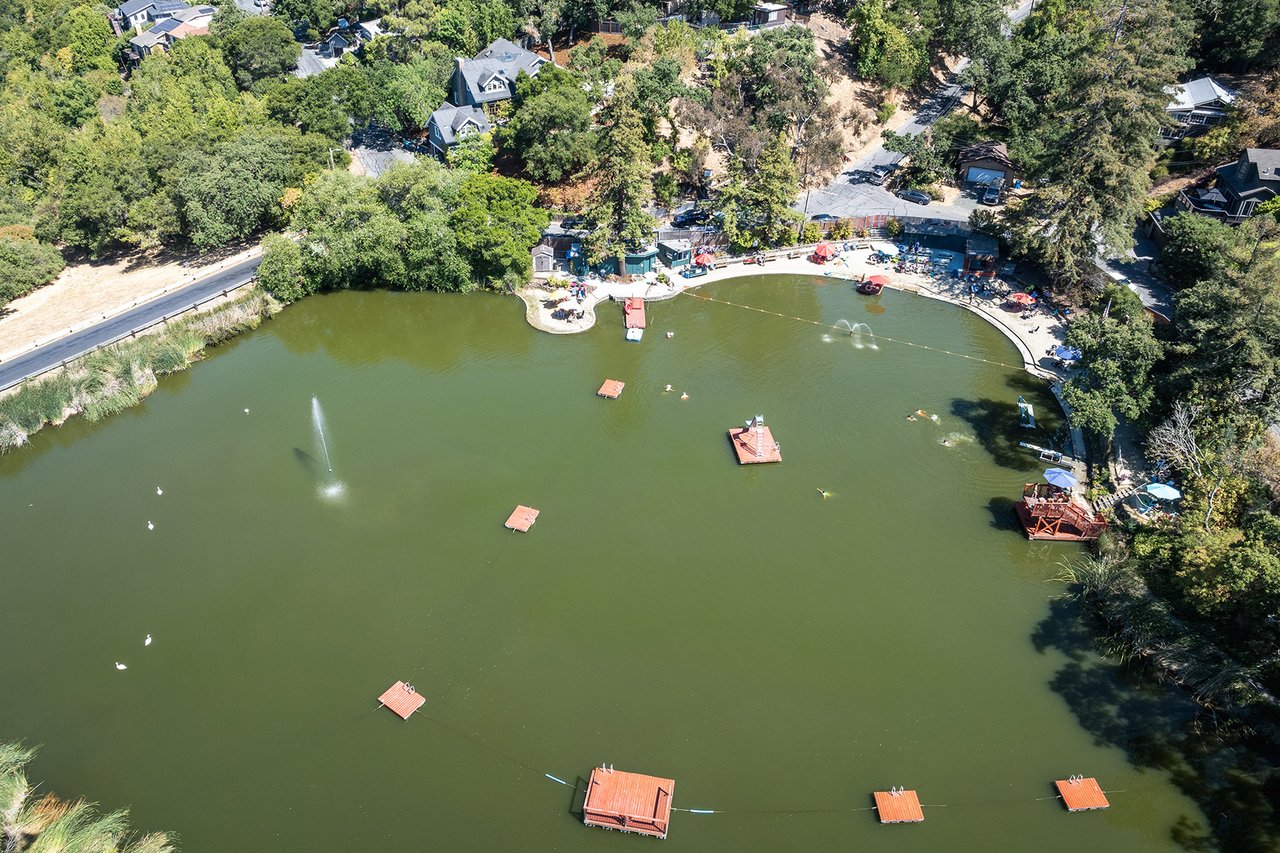
The jurisdictional patchwork is not the only place Emerald Hills relies on private, resident-run structures instead of public ones. Handley Rock Park, a half-acre site built around a 50-foot sandstone formation, the largest of its kind in San Mateo County, is a county-approved private park operated by the Handley Rock Association, a group of local residents and rock-climbing enthusiasts, not a county or city parks department. The neighborhood's two small lakes follow a similar pattern. Upper Lake is owned outright by the eleven households that border it. Lower Lake is owned by fifty families, with roughly 105 additional households granted access as summer club members.
None of this is a red flag. It reflects a neighborhood where residents have historically preferred to manage shared assets themselves rather than hand them to a municipal agency, a preference that shows up in how the area's infrastructure, from a climbing rock to a septic line, tends to answer to a small, specific group rather than a single city hall. For a buyer, the lesson generalizes: assume nothing about who is responsible for what until you confirm it for the specific parcel.
Before You Order an Inspection
A few steps, taken before an offer is written rather than after, prevent the three-week delay described at the start of this piece:
- Confirm the parcel's actual governing jurisdiction, county or Woodside, rather than relying on the Redwood City mailing address.
- Ask whether the property is currently on septic or connected to sewer, and if septic, whether the system predates or postdates the neighborhood's 1982 conversion.
- If septic, budget for a licensed inspection, which typically runs a few hundred dollars for a standard evaluation, understanding that a failed drain field or tank can mean a substantially larger repair conversation before closing.
- If any post-close renovation is planned, check whether Woodside's Municipal Code Section 151.20 site development permit applies, since that determines whether the town's Planning Department enters the process alongside the county.
A Short FAQ
How do I find out which jurisdiction governs a specific Emerald Hills parcel? Start with the property's assessor parcel number and ask directly whether it falls within Woodside's town limits or unincorporated San Mateo County. This is a factual question with a factual answer, and it should be settled before, not during, escrow.
If a home is already connected to sewer, is there no environmental review at all? A sewer connection removes the septic permit question, but land use referrals to County Environmental Health Services can still apply if a project involves a well, shared water supply, or work that falls outside a regulated system.
Does a failed septic inspection kill a sale? Not typically. It usually shifts the conversation toward repair credits or a completed repair prior to close, but the timeline and cost depend on what the inspection finds, which is exactly why ordering the right inspection early, rather than assuming based on a neighbor's experience, protects both sides of the transaction.
Emerald Hills rewards buyers and sellers who ask the specific question rather than the general one. If you are weighing a purchase or preparing to list a property here, Helen & Brad Miller can help you confirm exactly which rules apply to your parcel before you are three weeks into escrow wondering why. Reach Out Today.